GOVERNANCE FOR GROWTH IN INDIA by A.P.J. Abdul Kalam
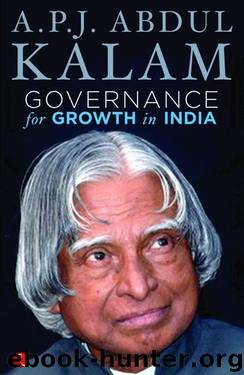
Author:A.P.J. Abdul Kalam [Kalam, A.P.J. Abdul]
Language: eng
Format: epub
Publisher: Rupa Publications
Published: 2014-05-14T18:30:00+00:00
Transparency is the basis of good governance, and a clean conscience is the basis of transparency. Once the conscience is clear there can be no difficulty in making one’s actions an open book. Similarly, in a government, making information available to all the stakeholders of the system is not only commendable but essential for the better functioning of the state.
The Effects of Corruption
Righteousness in the heart
leads to order in the nation.
Certain Experiences in Governance
It is well known that in government schemes and welfare projects, sometimes there is fictitious reporting or the full money allotted is shown as spent and claims of objectives being fully met are not backed up by proper evidence to corroborate the claims.
Thus we can see that in the absence of a non-transparent system, a well-intentioned programme fails to produce the desired results. This clearly shows the effect of corruption on governance and the failure of our system to protect the human rights of citizens.
The next area I would like to touch upon is the corruption level as reported in different states based on certain studies.
The levels vary from one state to next and the reasons for this should be established. Can it be due to political awareness? Can it be due to better Human Development Index? Can it be due to an alert media? Can it be due to women’s empowerment? It may be useful to study these aspects and assess the possible reasons, so that they can be emulated by other states.
Identifying the Heroes
In any village or panchayat or district, we will always find at least a few corruption-free good human beings. We may even find pockets of corruption-free societies. If these can be identified and celebrated, we can create a nearly corruption-free state. The real-world examples of corruption-free individuals and groups and societies must be discussed publicly, so that they can become examples to be followed in the country. A nation can be corruption free only when its states are corruption free; a state can be corruption free only if its districts are corruption free; a district can be corruption free only if its panchayats are corruption free; a panchayat can be corruption free only if the people are corruption free; and people can be corruption free only if they have imbibed these values from their childhood.
Certain Experiences in Societal Life
The creation of a corruption-free society depends heavily on the environment at home, the school, the society and the government, besides on the individual. Let me discuss the various components of this complex fabric.
Corruption-Free Society Starts at Home
On 21 November 2005, I visited Adichunchanagiri Math to attend a function of the Foundation for Unity of Religions and Enlightened Citizenship. There, I interacted with over 54,000 students of various schools and colleges of Karnataka. There, a tenth-standard student, M. Bhavani, studying at Adichunchanagiri Composite High School, Shimoga, asked me the following question: ‘Sir, I would like to be a citizen of a corruption-free nation. Please tell me, as a student, how can I contribute?’
The agony of a young mind is reflected in this question.
Download
This site does not store any files on its server. We only index and link to content provided by other sites. Please contact the content providers to delete copyright contents if any and email us, we'll remove relevant links or contents immediately.
Personalized inhaled bacteriophage therapy for treatment of multidrug-resistant Pseudomonas aeruginosa in cystic fibrosis by unknow(174831)
CONSORT 2025 statement: updated guideline for reporting randomized trials by unknow(83236)
Critical evaluation of the ProfiLER-02 study design and outcomes by Vivek Subbiah & Razelle Kurzrock(82902)
Cardiac gene therapy makes a comeback by Oliver J. Müller & Susanne Hille & Anca Kliesow Remes(82750)
Whisky: Malt Whiskies of Scotland (Collins Little Books) by dominic roskrow(74436)
Unveiling the design rules for tunable emission in graphene quantum dots: A high-throughput TDDFT and machine learning perspective by Şener Özönder & Mustafa Coşkun Özdemir & Caner Ünlü(50890)
A yeast-based oral therapeutic delivers immune checkpoint inhibitors to reduce intestinal tumor burden by unknow(40259)
Covalent hitchhikers guide proteins to the nucleus by Alexander F. Russell & Madeline F. Currie & Champak Chatterjee(40215)
Meet the Authors: Christopher R. Mansfield and Emily R. Derbyshire by Christopher R. Mansfield & Emily R. Derbyshire(40094)
Alkaline-earth metals promote propane dehydrogenation with carbon dioxide through geometric effects: Altering the reaction pathway by unknow(32730)
Induced iron vacancies boosting FeOOH loaded on sustainable Fenton-like collagen fiber membrane for efficient removal of emerging contaminants by unknow(32504)
Efficient electric-field-assisted photochemical conversion of methane to n-propanol exclusively over penetrated TiO2Ti hollow fibers by Guanghui Feng(32452)
Bi2SiO5 nanosheets as piezo-photocatalyst for efficient degradation of 2,4-Dichlorophenol by Hangyu Shi & Yifu Li & Lishan Zhang & Guoguan Liu & Qian Zhang & Xuan Ru & Shan Zhong(32384)
A novel NDIPTA organic heterojunction photocatalyst with built-in electric field for efficient hydrogen production by Jiahui Yang & Baojun Ma & Yongfa Zhu(32360)
Enhanced conversion of methane to liquid-phase oxygenates via hollow ferrite nanotube@horseradish peroxidase based photoenzymatic catalysis by Jun Duan & Shiying Fan & Xinyong Li & Shaomin Liu(32330)
Ordered macroporous superstructure of defective carbon adorned with tiny cobalt sulfide for selective electrocatalytic hydrogenation of cinnamaldehyde by Xiao-Shi Yuan & Sheng-Hua Zhou & San-Mei Wang & Wenbo Wei & Xiaofang Li & Xin-Tao Wu & Qi-Long Zhu(32256)
What's Done in Darkness by Kayla Perrin(27144)
Topological analysis of non-conjugated ethylene oxide cored dendrimers decorated with tetraphenylethylene: Insights from degree-based descriptors using the polynomial approach by A Theertha Nair & D Antony Xavier & Annmaria Baby & S Akhila(26522)
Investigation of mechanical and self-healing properties of hydroxyl-terminated polybutadiene functionalized with 2-ureido-4-pyrimidinone by Mohsen Kazazi & Mehran Hayaty & Ali Mousaviazar(26457)
